Bag rolls, the parts that wear, the optional pads that let a free-standing machine sit on polished stone without a mark, and the few things you can add later. Nothing drills, nothing plugs in. Four groups, listed below.
Power
Nothing to plug in
The machine is mechanical and free-standing. Those two decisions shape the whole parts list — no electrician, no drill, no plumber on delivery day.
The machine
Mechanical wrapping
The guest pushes the umbrella in and the sleeve follows. No motor, no mains, no electrical service interval. A door with no socket nearby is not a reason to skip the machine. It stands on its own weight, and wheeled models roll on two rear casters, so the door it serves can change with the season.
The option
A cell, if you want an alert
The only powered part is an optional low-bag indicator on a removable cell, swapped in seconds. Remove it and the machine still wraps. It ships detached, so a crate of dispensers clears air freight without battery paperwork.
A removable battery is offered as an alert module, not as a power source. Cells add UN38.3 handling to a shipment and a maintenance task to a lobby; neither buys you a drier floor.
Catalogue
Four groups
Ordered by what happens to them: used up, worn out, laid under the base, added later.
01Consumables
Bag rolls
The only thing a lobby uses up.
Short sleeves
Folding and compact umbrellas, up to about 55 cm.
Long sleeves
Full-size umbrellas, up to about 85 cm.
PE or biodegradable
Same sizes. A policy choice, not a machine choice.
Printed sleeves
Your mark on the bag, on distributor lots.
Reordered by the roll, sized per door.
02Wear parts
What takes the abuse
Everything a guest or a housekeeping cart actually touches.
Bag cartridge
The insert the roll hangs on. Swapped, not repaired.
Sleeve mouth and guide ring
Where the umbrella passes through — the first place a bag starts to tear.
Foot pads and base ring
Flatten and scuff first on polished stone.
Rear tilt wheels
Fitted to wheeled models: the two casters at the back take the threshold and curb knocks.
Sold as a spares kit — one per site is enough to start.
03Placement kit
Free-standing, no drilling
Nothing is anchored. These only protect the floor and level the base.
Anti-slip pads
Keeps the weighted base from walking across marble.
Stone-safe floor pad
A soft interface under the base for polished stone or timber.
Level shims
For uneven thresholds and door ramps.
Spare tilt wheels
The rear caster pair for wheeled models, if a threshold ever chips one.
Optional. The machine stands without any of it; wheeled models roll on their own casters.
04Upgrade parts
Optional, added later
None of these are needed for the machine to work.
Drip tray
Catches the last drops under the mouth. Empty by hand — no drain.
Off-season cover
Closes the sleeve path and keeps dust off in the store room between rainy seasons.
Low-bag alert
A small indicator on a removable cell. An alert, not a dependency.
Branding plate
Laser-etched nameplate. See OEM.
Fitted to the same base, at any time.
Shown: a cartridge swap at a hotel entrance. No tools, and the only routine a lobby performs on the machine itself.
Where these parts sit
Factory reference details from the column range: the operating mouth and guide ring, the bag panel, and the rear casters. The mouth profile and base on your quote are confirmed on a sample.
First order
First-order set
One crate, and the door works the day it is opened.
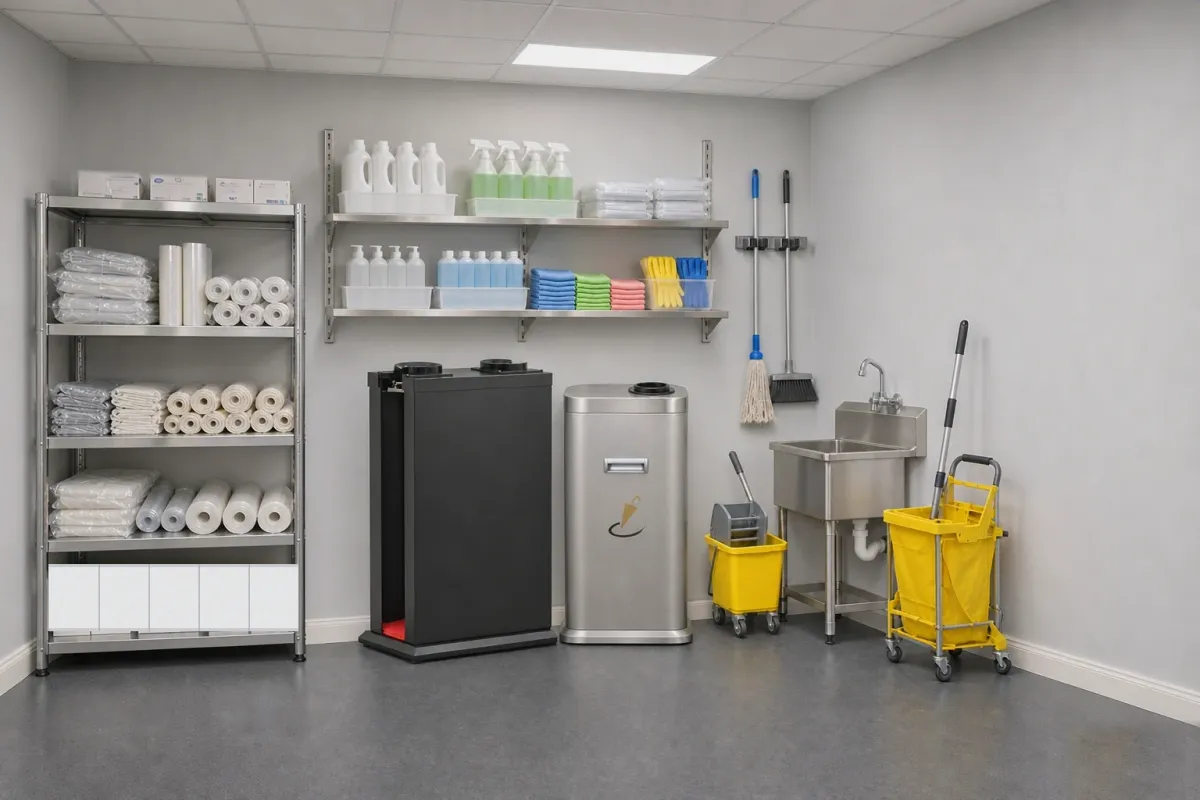
Shown: machines parked beside the sleeve-roll stock in a housekeeping store room, with refills and cleaning supplies close to hand.
The set is the honest minimum: a machine, enough bags to prove the reorder rhythm, the pads that keep it gentle on your floor, and a tray so the last drops have somewhere to go. It arrives standing, not mounted — on wheeled models, tilt it onto its rear casters, roll it to the door, and it is working. Anything in the upgrade column can be added later on the same base — nothing in this list is a hostage.
Tell us the entrances and the bag mix. We return a machine, a starting stock, a tray and the optional floor pads as one line — or a spares list for a machine you already run.